What Is the 40/20/40 Rule for Meetings?
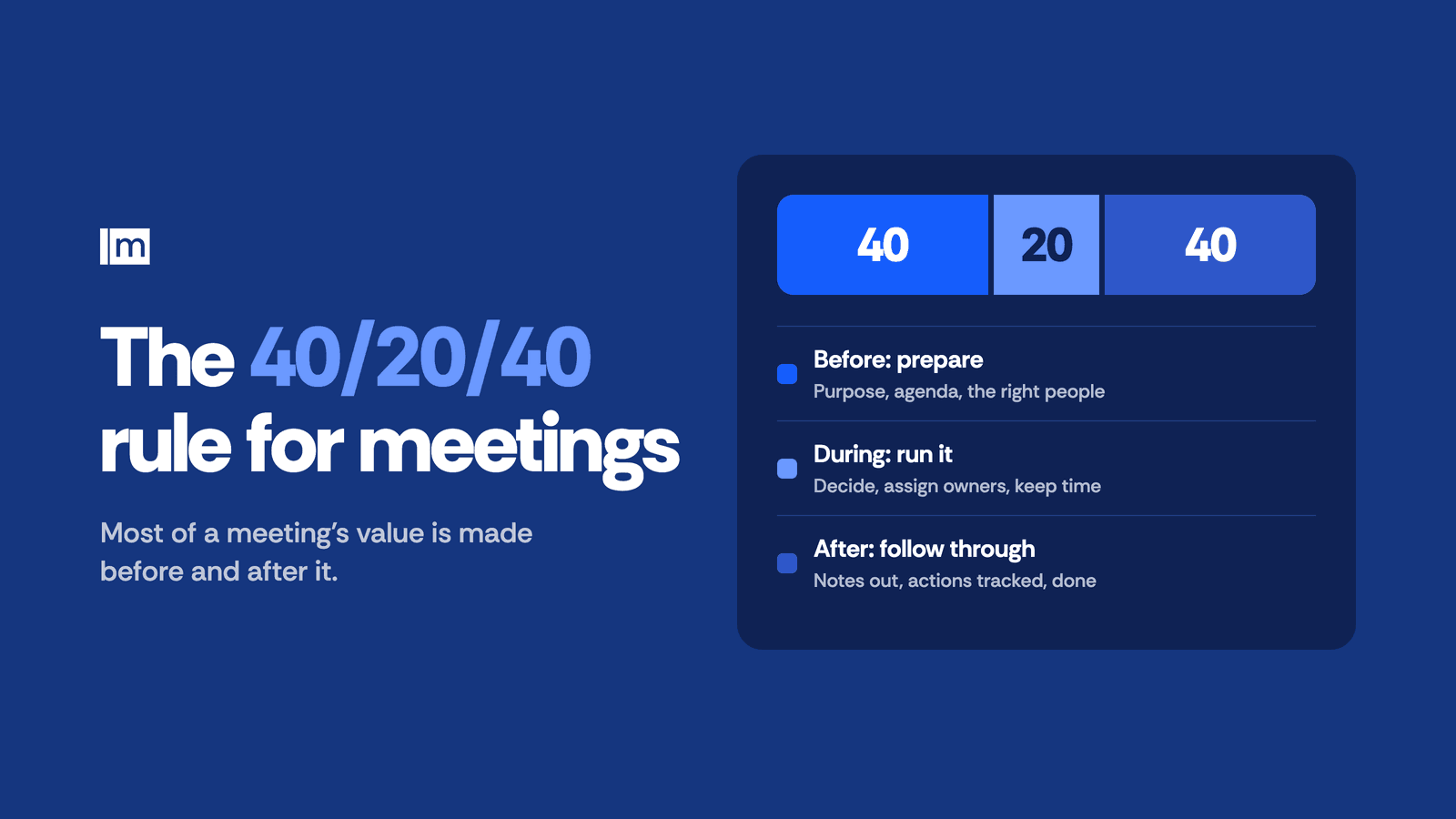
The short answer: The 40/20/40 rule for meetings says 40% of the effort behind a meeting should go into preparing for it, 20% into the meeting itself, and 40% into following it up. The split is a guide to attention, not a stopwatch: it says a meeting's value is mostly made before and after the call. Graham Allcott and Hayley Watts set it out in their 2021 book How to Fix Meetings. Allcott had already written about it in 2012, crediting the idea to Lois Graessle and George Gawlinski, who worked on the book Meeting Together. The rule exists because most meetings fail outside the room: no clear purpose going in, no owner or deadline coming out.
Most teams invert it. They spend almost nothing before the call, the whole hour in it, and nothing after, then wonder why the same topic comes back next week.
The 40/20/40 rule at a glance
| Phase | Share of effort | What it covers | The question it answers |
|---|---|---|---|
| Before | 40% | Purpose, agenda, the right people, pre-reading | Why are we meeting, and what will we decide? |
| During | 20% | Running the discussion, making decisions, assigning owners | What did we decide, and who does what? |
| After | 40% | Notes sent, actions tracked, decisions acted on | Did the meeting change anything? |
Where does the 40/20/40 rule come from?
The 40/20/40 rule is best known from How to Fix Meetings (2021) by Graham Allcott and Hayley Watts, who use it to plan, run and manage meetings. A Sheridan College library guide summarises their version: 40% of your attention on preparing, 20% on the meeting itself, 40% on the follow-through.
The idea is older than the book. In a 2012 TrainingZone article, Graham Allcott wrote that the 40-20-40 principle was developed by Lois Graessle and George Gawlinski, who worked on the book Meeting Together. So when an answer credits only the 2021 book, it is half right: the 2021 book popularised the rule, and the rule itself predates it.
What goes into the first 40%: preparing?
The first 40% of the 40/20/40 rule is preparation, and it decides whether the meeting is worth holding at all. Preparation covers four things:
- A purpose in one sentence. "Decide the launch date" is a purpose; "launch sync" is a calendar label.
- An agenda with outcomes. Each item says what should exist when it ends: a decision, a list, an owner.
- The right people only. Anyone who is not deciding or contributing can read the notes afterwards.
- Pre-reading sent early. If people read the numbers before the call, the meeting is spent on the decision, not on reading.
A ready-made structure saves most of this work. The meeting agenda template with action items puts the purpose, the decisions needed and the owners on one page.
Preparation also includes deciding not to meet. If the purpose is to share an update nobody needs to discuss, a written note does the job in less time for everyone.
Why does the meeting itself get only 20%?
The meeting gets 20% because the 40/20/40 rule treats the call as the shortest and least valuable part of the work. If the first 40% was done, the meeting is short: people arrive having read the material, the agenda says what must be decided, and the time goes on the decision.
Three habits keep the 20% at 20%:
- Decide out loud. State each decision as a sentence before moving on, so nobody leaves with a different version.
- Name an owner and a date for every action. "We should look into it" is not an action item; "Priya sends the vendor shortlist by Friday" is.
- Stop when the agenda is done. A 30-minute slot that ends in 20 minutes is the rule working.
What goes into the last 40%: following through?
The last 40% of the 40/20/40 rule is follow-through, and it is where most meetings quietly fail. Follow-through means the notes go out, every action item has an owner and a deadline, and someone checks that the actions happened before the next meeting.
The usual failure is not laziness but friction. Someone has to turn a page of rough notes into a summary, chase the owners, and remember what was said about each item. That is why the follow-up 40% is the part most teams skip, and why the same topics come back week after week.
Good follow-through has four parts:
- Notes sent within the day, while people still remember the discussion.
- Decisions written as decisions, separate from the discussion that led to them.
- Action items with owners and dates, in one list everyone can see.
- A check at the next meeting: each open action is either done or has a new date.
The guide to writing meeting minutes covers what to record, and the meeting minutes template for action items gives a layout to copy.
Can software do part of the follow-up 40%?
Yes. Meeting note-taking software takes over the most manual part of the follow-up 40%: writing the notes. Meetbook, for example, records the meeting and writes the summary and the action items with owners when the call ends, with each point linked to the quote, speaker and timestamp it came from. Meetbook can send the notes to Slack or Notion, so they reach the team without anyone copying them across. The AI meeting minutes generator shows what those notes look like.
Software does not do the judgement. A person still decides what matters, chases an action that slips, and decides whether the next meeting is needed. What changes is that the follow-up 40% starts from finished notes instead of a blank page.
How do you apply the 40/20/40 rule to a 30-minute meeting?
Read the 40/20/40 rule as a share of attention, not a timesheet. For a 30-minute weekly meeting, a practical version looks like this:
- Before (the day before): write the one-sentence purpose, list the two or three decisions needed, send any numbers people must read.
- During (30 minutes or less): take each decision in turn, say it out loud, name the owner and the date.
- After (the same day): send the notes with decisions and action items, then open the next meeting with the open actions.
If following the rule literally would cost more time than the meeting is worth, the meeting is probably the problem, not the rule.
FAQ
What is the 40/20/40 rule for meetings?
The 40/20/40 rule says 40% of the effort behind a meeting goes into preparation, 20% into the meeting itself and 40% into follow-up. It is a guide to where attention should go, not a fixed timesheet.
Who created the 40/20/40 rule?
Graham Allcott and Hayley Watts popularised it in their 2021 book How to Fix Meetings. In 2012, Allcott credited the principle to Lois Graessle and George Gawlinski, who worked on the book Meeting Together.
Why is preparation 40% of a meeting?
Preparation decides whether the meeting has a purpose, the right people and the material needed to decide. A meeting without that preparation usually ends without a decision.
What is the most skipped part of the 40/20/40 rule?
The follow-up 40% is the most skipped. Notes are not sent, action items have no owner, and the same topic returns at the next meeting.
Does the 40/20/40 rule mean meetings should be shorter?
Usually, yes. When preparation is done, the meeting needs less time, because it is spent on decisions rather than on catching people up.
Can AI help with the 40/20/40 rule?
Yes. AI note-taking software such as Meetbook writes the summary and action items with owners when the call ends, which removes the most manual part of the follow-up 40%.